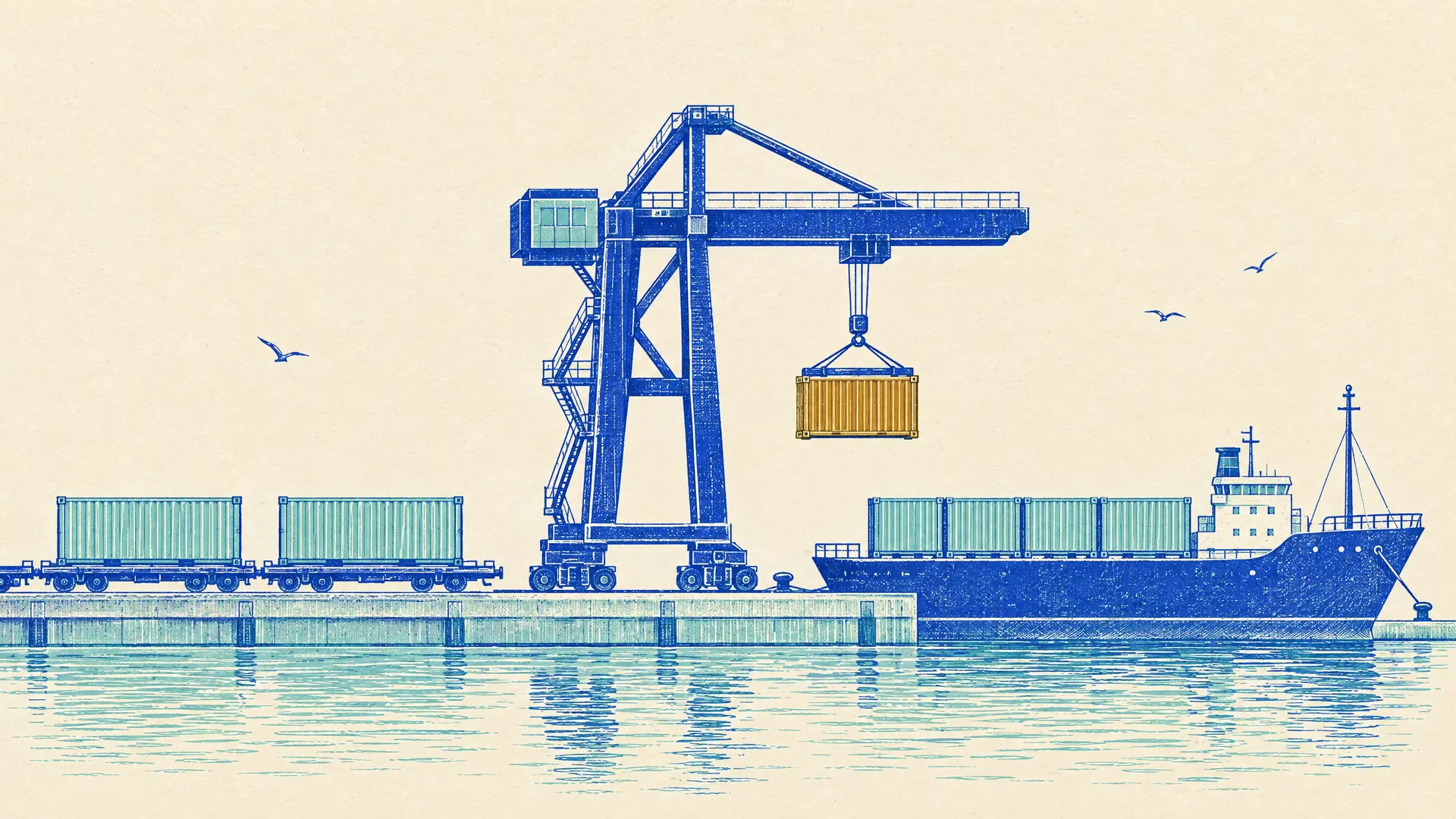
On 26 April 1956, a converted tanker called the Ideal X left Newark for Houston with 58 metal boxes on deck. Loading a ship by hand cost $5.86 a ton at the time. With the boxes, it cost 16 cents.
The box itself wasn’t clever. What changed the world was the agreement around it. Once ships, cranes, trucks and trains all accepted the same box, goods could move anywhere without being unpacked and repacked at every handover.
AI in supply chain is still in the pre-container era. Every AI tool needs its own custom connection to every system: the ERP, the transport system, the warehouse system, the supplier portal. Each connection is built by hand, and each one breaks when something changes.
The Model Context Protocol, or MCP, is the container standard for AI. Most people outside IT have never heard of it. But I think it will matter more to supply chain than the next model release.
What MCP is
MCP is an open standard for connecting AI models to the systems and data they need. Anthropic introduced it on 25 November 2024. In December 2025, it handed MCP over to the Agentic AI Foundation, a new Linux Foundation fund co-founded with Block and OpenAI. That matters: no single AI vendor owns the standard anymore.
In plain words, it works like this. You wrap a system, say your ERP, in a small program called an MCP server. The server tells any AI tool, in plain language, what it can offer. The AI tool reads that menu and decides what to use to answer your question.
A server can offer three kinds of things:
- Tools: actions the AI can call, such as “get stock by warehouse” or “create a transfer proposal”.
- Resources: data or documents it can read, such as a procedure or a price list.
- Prompts: ready-made instructions for recurring tasks.
The adoption has been fast. OpenAI adopted MCP in March 2025 and Google DeepMind followed in April. Today it works in ChatGPT, Gemini, Microsoft Copilot and Claude. In December 2025, Anthropic reported more than 10,000 active public MCP servers and over 97 million monthly downloads of the software kits.
For supply chain, one announcement stands out. On 20 May 2026, SAP and Anthropic announced that Claude will work with SAP’s Joule assistant through MCP, covering finance, procurement and supply chain workflows. When the biggest ERP vendor speaks the standard, it stops being a developer toy.
What it means for supply chain
Supply chain runs on many systems that barely talk to each other. That’s exactly the problem MCP was built for. Picture three AI tools and six systems:
| Without a standard | With MCP | |
|---|---|---|
| Connections to build | 3 × 6 = 18 custom connectors | 6 servers, usable by all 3 tools |
| Adding a new system | One connector per AI tool | One server |
| Switching AI vendor | Rebuild the integrations | Keep the servers |
| Deciding what AI may see and do | Scattered across 18 connectors | One place per system |
That last row is the one I’d put in front of a CIO. A standard doesn’t only save build time. It gives you one clear place to control access.
What this makes possible:
- A control tower without a new platform. An assistant reads the ERP, the transport system and the warehouse system directly, without a data lake project first.
- Legacy systems back in the game. Wrap an old warehouse database once, and every AI tool can use it.
- Freedom to switch models. Your integrations survive when a better model arrives next quarter.
- Cross-system answers. Questions that need three systems, like “why is this order late?”, get answered in one go.
- Supplier collaboration. In time, you could offer key suppliers a limited server with forecasts and open purchase orders for their own AI tools.
The best way to see it is on an everyday question that crosses systems.
Worked example: “Can you deliver 12 bikes by Friday the 13th?”
Meet Upshift, a fictional bicycle maker with two plants and five distribution hubs. A dealer in Lyon emails customer service: can you deliver 12 Gravel E bikes, frame size M, by Friday 13 November?
Today, answering takes a day. Customer service checks stock in the ERP, emails planning about production, looks up transit times in the transport system, and replies the next morning. By then, the dealer may have called a competitor.
Step 1: wrap each system in a server
IT builds one MCP server per system, each with a few well-described tools:
| Server | Tools it offers | Access |
|---|---|---|
| ERP | stock by hub, open orders, planned production | Read only |
| Transport system | transit time from hub to postcode | Read only |
| CRM | dealer profile and default hub | Read only |
| Order desk | propose a stock reservation | Write, needs human approval |
Step 2: see how small a server is
This is the core of the ERP server in Python, using the official MCP software kit. The erp object stands for your own data-access code.
from mcp.server.fastmcp import FastMCP

mcp = FastMCP("upshift-erp")

@mcp.tool()
def stock_by_hub(item: str) -> dict:
    """Free stock of an item at each distribution hub, after reservations."""
    return erp.free_stock_by_hub(item)

@mcp.tool()
def planned_production(item: str, weeks: int = 4) -> list:
    """Planned output of an item per plant for the coming weeks."""
    return erp.production_plan(item, weeks)

if __name__ == "__main__":
    mcp.run()
Notice the descriptions in plain English. They are what the AI reads to decide which tool to use, so they deserve as much care as the code.
Step 3: ask the question
The customer service agent pastes the dealer’s email into their AI assistant. Behind the scenes, the assistant calls the tools it needs. Illustrative results:
- CRM, dealer profile: the Lyon dealer is normally served from Hub South.
- ERP, stock by hub: Hub South has 3 free, Hub Central has 9 free.
- Transport system, transit times: Hub South to Lyon takes 1 day, Hub Central to Lyon takes 3 days.
- ERP, planned production: the next batch is too late for 13 November.
The assistant answers in plain language. Ship 3 bikes from Hub South and 9 from Hub Central. Dispatch from Central by Tuesday 10 November, and all 12 arrive by Friday. It then proposes the two reservations.
Step 4: a human confirms
The reservation is a write action, so the agent sees a proposal and clicks approve. The dealer gets a firm answer within minutes instead of the next morning.
What to notice: the assistant never touched a database directly. It only used tools that IT chose to expose, with read-only access by default. And the same four servers would work tomorrow with a different AI assistant, without rebuilding anything.
What MCP can’t do, and the traps
- A standard is not an integration. Someone still has to build, test and maintain each server. And if the stock figure in the ERP is wrong, MCP delivers the wrong figure faster.
- Security is the big one. In April 2025, researchers showed attacks through prompt injection and poisoned tools that can leak data across connected systems. Only use servers from sources you trust, and review what each one can do.
- Permissions need design. Start read-only. Put a human approval on every write action. Make the server act with the user’s own rights, never as an all-powerful system account.
- Descriptions make or break it. Vague tool descriptions lead to wrong tool calls. Test every server with twenty real questions from the people who will use it.
- It’s still young. The standard is less than two years old and still evolving, and the quality of vendor servers varies. Treat each new server as a pilot until it proves itself.
Where to begin
This week, write down five questions your team answers every day that need more than one system. “Can we deliver this by Friday?” is a good one. “Why is this order late?” is another. Then ask IT which of those systems already offers an MCP server, because many software vendors now ship one.
Pick one question and one read-only connection, and try it in the AI tool you already use. You’ll learn more from that small test than from any vendor demo.
The container didn’t make ships faster. It made everything connect. MCP won’t make AI smarter, but it will make AI useful where supply chain actually runs: across systems.
So tell me: which system would you connect first?