The core series
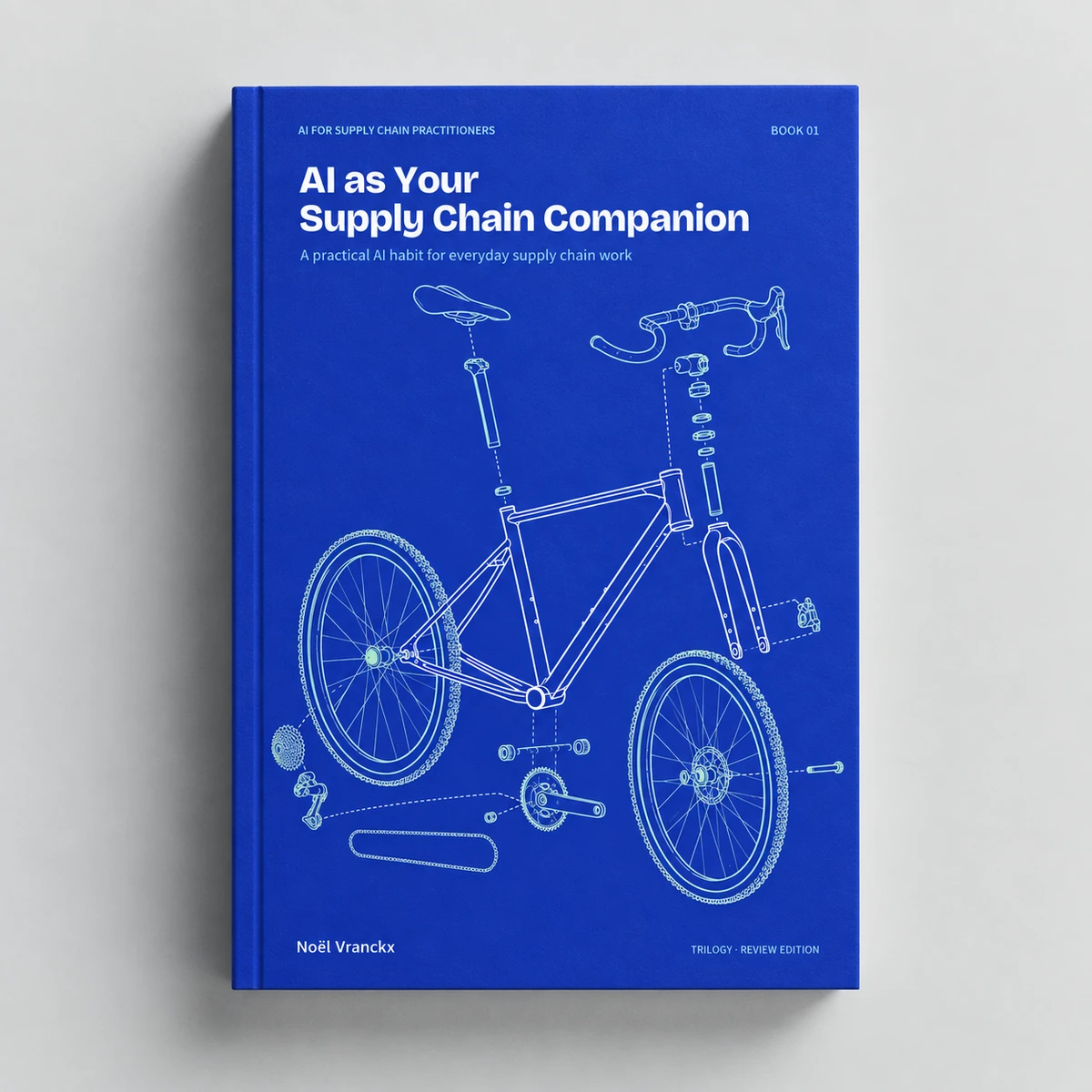
AI as Your Supply Chain Companion
Book 1 of 3 · Use AI
Build a daily AI practice, a reusable prompt library, and a habit of checking results.
Get the free bookFree with an account. Accounts are by invitation for now; join the waiting list and the book is yours when you’re in.
 Free with an account
The idea behind the book
What you’ll learn.
Start with the everyday work of a supply chain practitioner: reading supplier agreements, reviewing orders, writing summaries, exploring data, and preparing decisions. Learn how to give an AI assistant useful context and check its answer against the evidence.
The first book in the three-part series helps you build a practical AI habit and a reusable prompt library. Exercises use the fictional bicycle company Upshift, with source files and clear checks for each result.
Inside the book
Table of contents.
- 01
Three ways to use AI in supply chain
p. 7 - 02
What a practitioner must know about language models
p. 15 - 03
The landscape: models, products, languages, tools
p. 24 - 04
Writing and summarising
p. 32 - 05
Talking to your data
p. 46 - 06
The thinking partner: scenarios and decisions
p. 57 - 07
Research, regulation and the outside world
p. 72 - 08
Your personal AI operating system
p. 84
Included with the book
Hands-on exercises.
Every book comes with exercises you do yourself. Read a chapter, then practise its method on realistic files until you can use it on your own work.
Practice files
Work on data made for the exercise.
Each exercise comes with files from Upshift, the fictional bicycle company in the books: agreements, orders, emails and spreadsheets, ready to give your AI.
A guide for every step
Know what to do next.
A walkthrough tells you what to give the AI, what to ask it, and how to check its answer against the sources.
A reference to check against
See how your result compares.
Compare your answer with a worked reference, mark the exercise done, and follow your progress through the book in your workbench.