The core series
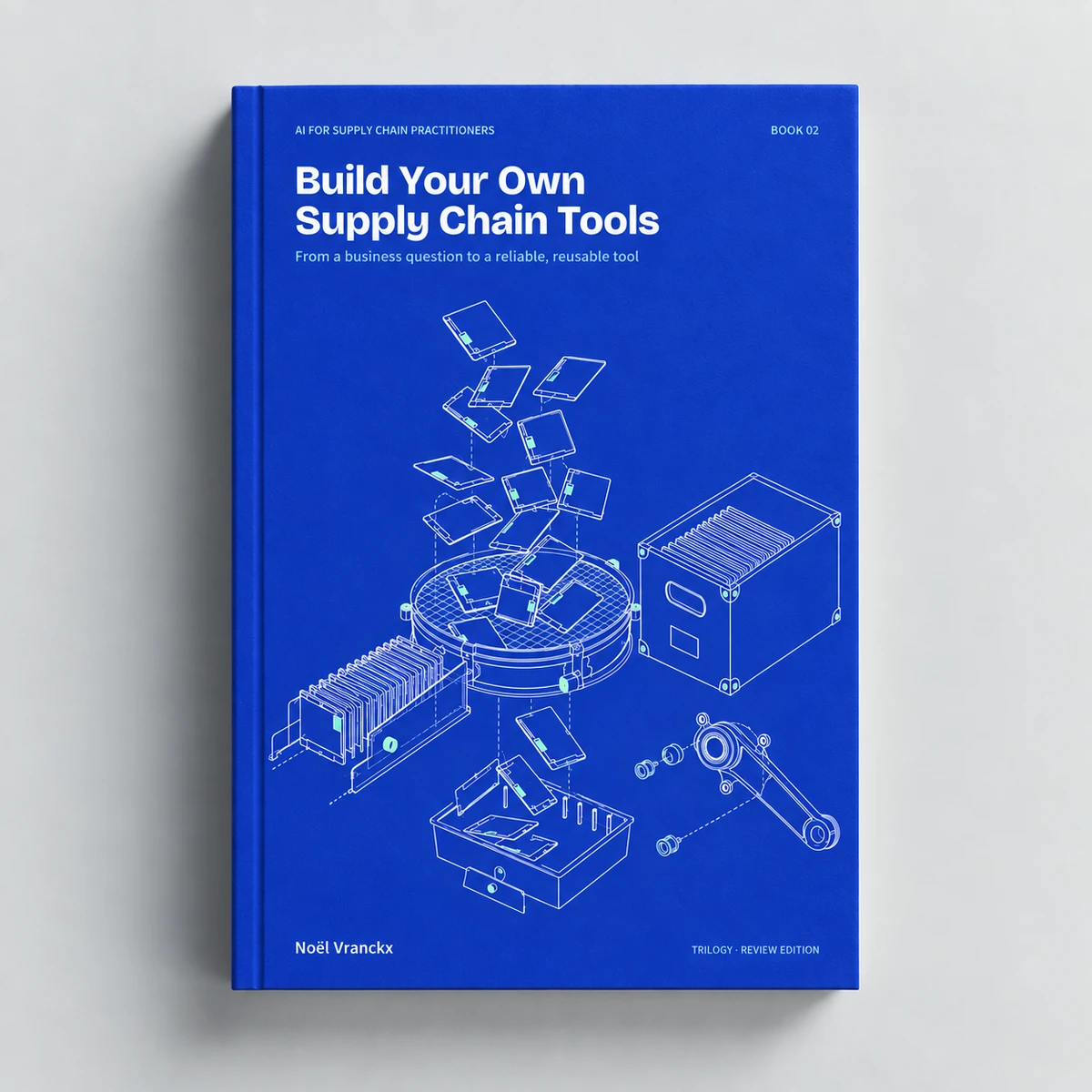
Build Your Own Supply Chain Tools
Book 2 of 3 · Build tools
Specify, build, test, and share tools that work on your data.
This book will be released soon. Leave your email and we’ll let you know the day it’s out.
Purchasing opens soon. The price is €9.99.
 Available soon
The idea behind the book
What you’ll learn.
Turn a recurring business question into a tool your team can use again. Work from requirements to a working calculation, then test the inputs, results, and decisions before sharing it.
The second book in the series covers classification, safety stock, forecast accuracy, inventory optimization, network allocation, and scheduling. Build with an AI coding assistant while keeping the business logic and checks in your hands.
Inside the book
Table of contents.
- 01
From user to architect
p. 9 - 02
Classifying and scoring
p. 23 - 03
Safety stock and inventory projection
p. 33 - 04
The forecast accuracy dashboard
p. 44 - 05
The inventory optimiser
p. 54 - 06
The network allocation model
p. 64 - 07
Loads and schedules: when you need a solver
p. 75 - 08
Tools that last: testing, versioning, sharing
p. 87
Included with the book
Hands-on exercises.
Every book comes with exercises you do yourself. Read a chapter, then practise its method on realistic files until you can use it on your own work.
Practice files
Work on data made for the exercise.
Each exercise comes with files from Upshift, the fictional bicycle company in the books: agreements, orders, emails and spreadsheets, ready to give your AI.
A guide for every step
Know what to do next.
A walkthrough tells you what to give the AI, what to ask it, and how to check its answer against the sources.
A reference to check against
See how your result compares.
Compare your answer with a worked reference, mark the exercise done, and follow your progress through the book in your workbench.